

Hair salon SEO is the process of optimizing your website and Google Business Profile so your salon appears when nearby clients search for hair services on Google Search and Google Maps. To rank higher, a salon needs a website Google can understand, an optimized Google Business Profile, service-based local keywords, dedicated service pages, genuine reviews, and consistent local citations.
A good hair salon SEO strategy starts with one simple reality: people search differently when they are ready to book.
They search “hair salon near me,” “balayage salon in [city],” “best hair colorist near me,” or “curly hair specialist in [neighborhood].”
These are not casual searches. They are specific, local, and often tied to someone actively deciding where to book.
Hair salon SEO helps your website and Google Business Profile clearly communicate what you offer, where you are, who you serve, and why your salon should show up in those moments.
Done well, it can be the difference between a missed opportunity and a booked appointment.
Here are 11 practical steps to improve your hair salon SEO and strengthen your local visibility.
1. Have a website Google can understand
Before you can rank higher on Google, your salon needs a website. Period. There’s just no other way to go about this one.
And we’re talking about not just a page with your logo, hours, and booking link, but a website that clearly tells people and search engines what you offer, where you are, and why your salon is worth choosing.
Website builders like Wix, Weebly, or Squarespace can be helpful starting points. They make it easy to get online quickly, especially for newer salons.
But there is a trade-off: the easier a website is to build, the more limited it can be when you need deeper SEO control.
That does not mean these platforms cannot rank. They can. But as your salon grows, a more flexible website structure can give you better control over technical SEO, schema markup, page speed, service pages, mobile experience, and booking flow.
For many growing salons and beauty businesses, WordPress is often the stronger choice because it gives you more flexibility for SEO plugins, custom service pages, blog content, schema, and future growth.
At a minimum, your website should make these things clear:
- What services you offer
- Where your salon is located
- Who you serve
- How clients can book
- Why people should trust you
Your website should not just sit there like a digital brochure. It should help people find you, trust you, and book.
If you are still wondering whether your beauty business needs a website beyond social media or a booking platform, this guide on why beauty businesses still need a website is a helpful place to start.
2. Optimize your Google Business Profile and connect it to your website
For local salons, your Google Business Profile is one of your most important discovery tools.
It can appear when people search for your salon by name as well as when they search for services nearby on Google Search or Maps.
Google explains local results primarily through three concepts:
Relevance: How closely your business matches what someone is searching for.
Distance: How far your business is from the searcher or location used in the search.
Prominence: How well-known or established the business appears based on signals such as reviews, links, and information available across the web.
You cannot control every part of local ranking, especially proximity.
You can, however, make it much easier for Google and potential clients to understand your business.
Start by claiming and verifying your Google Business Profile if you have not already done so.
Then complete the profile carefully:
- Use the salon’s real-world business name
- Add the correct address
- Add the correct phone number
- Link to your website
- Add accurate regular and special hours
- Include your booking link
- Choose the most specific primary business category
- Add only genuinely relevant secondary categories
- List your services
- Write useful service descriptions
- Add appropriate business attributes
- Add your service area when applicable
- Upload current photos and videos
Avoid using categories simply because they contain keywords you would like to rank for.
Your categories should accurately describe the core business.
For example, a hair salon may use Hair Salon as its primary category and add another available category only when that category represents a genuine part of the business.
Do not treat categories as a substitute for your service list.
Your profile should also remain active and accurate.
Regularly:
- Add new photos
- Check your hours
- Update services
- Respond to reviews
- Make sure your website works
- Check your booking link
- Review any information Google or users have suggested changing
A complete profile will not guarantee a particular ranking, but it gives Google stronger information about your business and makes the listing more useful to potential clients.
Your website, booking platform, social profiles, and major directory listings should also use consistent business information.
For a deeper walkthrough, read this guide on how to optimize your Google Business Profile.
3. Choose Hair Salon SEO keywords based on real services
A common mistake salons make is trying to rank for broad or head terms only, like “hair salon” or “best salon.”
While those keywords matter, they are usually very competitive. More importantly, they may not reflect the exact services your ideal clients are searching for.
Instead, think about the services that actually bring people into your salon.
Examples include:
- Balayage salon
- Hair colorist
- Blonde specialist
- Curly hair salon
- Hair extensions
- Bridal hair stylist
- Keratin treatment
- Color correction
- Men’s haircut
- Kids haircut
- Blowout salon
Then combine those services with local intent.
For example:
- Balayage salon in San Mateo
- Hair extensions near me
- Curly hair specialist in San Francisco
- Best hair colorist in [city]
- Bridal hair salon near [neighborhood]
Specific keywords bring in better intent.
A client searching “balayage salon in San Mateo” is not just browsing inspiration. They are looking for a place to book.
Choose the services your salon wants to be known for, then build your website around those searches.
This is where hair salon SEO becomes more strategic. Instead of simply saying, “We do hair,” your website starts showing Google and potential clients exactly what you do best.
| Salon service | Keyword example | Best page to create |
| Balayage | Balayage salon in [city] | Balayage service page |
| Hair extensions | Hair extensions near me | Hair extensions service page |
| Color correction | Color correction salon in [city] | Color correction service page |
| Curly hair | Curly hair specialist in [neighborhood] | Curly hair service page |
| Bridal hair | Bridal hair stylist in [city] | Bridal hair service page |
| Blonde services | Blonde specialist near me | Blonde services page |
4. Build a dedicated, visual page for every service you offer
One general “Services” page is rarely enough for strong hair salon SEO. Dedicated service pages give you more room to answer questions, showcase results, explain your expertise, and target relevant service searches.
You do not, however, need a separate page for every small variation of every service.
Start with your major service categories.
For a hair salon, that might include:
- Hair color
- Balayage
- Hair extensions
- Curly hair
- Bridal hair
- Haircuts
- Treatments
- Styling
Then decide whether individual treatments deserve their own pages based on client demand, search behavior, business importance, and whether you have enough genuinely useful information to create a strong page.
A simple way to check is to search for the service in your target location and study what Google is already showing.
Before creating a page, search for the service in the location you want to target and study the results.
Are the strongest results broad category pages?
Or does Google frequently show pages dedicated to the exact service?
That can help you decide how specific your site structure should be.
This is where strong local SEO for beauty businesses can make a real difference, especially if your salon wants to show up for specific services in a specific city, neighborhood, or service area.
5. Localize your content beyond just the city name
Google needs to understand where your salon is relevant.
And no, adding your address in the footer is not always enough.
Your address matters, but your website should also make your location clear throughout the pages that matter most. This helps Google understand where to rank you, and it helps potential clients quickly know if your salon is close enough, convenient enough, and relevant to them.
If your salon is in a specific city, town, or neighborhood, make that clear in your page titles, headings, service pages, contact page, and body copy where it feels natural.
But strong local SEO goes beyond repeating your city name across your website.
Your content should also reflect how people in your area actually talk about places, neighborhoods, landmarks, and local routines.
For example, a salon in Half Moon Bay might not only mention “Half Moon Bay hair salon.” It could also reference local language and familiar places, such as “near the coastside,” “over the hill,” or seasonal events like the Half Moon Bay Pumpkin Festival.
Other useful local information can include:
- Neighborhoods you commonly serve
- Nearby cities clients travel from
- Major cross-streets
- Parking information
- Public transportation
- Recognizable nearby areas
- Directions
- Local wedding venues you regularly work with
- Genuine community partnerships
- Local events your salon actually participates in
6. Get more Google reviews and respond to them
For service-based businesses, Google reviews are the new word-of-mouth.
Reviews play a significant role in both local search rankings and how AI tools evaluate a business’s reputation. Detailed reviews that mention specific services or a particular stylist, a color treatment, or a result the client was happy with—give search engines concrete information about what the salon does well.
To build a steady stream of reviews:
- Ask happy clients to leave a review shortly after their appointment
- Respond to every review, positive or negative, in a professional tone
- When appropriate, reference the specific service in the response, which reinforces relevant keywords naturally
If asking for reviews feels awkward, this guide on how to get more Google reviews for your San Francisco beauty business offers practical ways to do it without sounding pushy.
7. Use high-quality photos and optimize Them
Hair salons are visual businesses. People want to see your work before they trust you with their hair.
That is why photos are important for both your website and your Google Business Profile.
Add photos of:
- Before-and-after transformations
- Hair color results
- Haircuts and styling
- Salon interiors
- Stylists
- Products
- Client experience moments
For your website, make sure your image files are not too large, because heavy images can slow down your site. You should also use descriptive file names and alt text.
Instead of uploading a file called:
IMG_4821.jpg
Use something like:
blonde-balayage-san-mateo-salon.jpg
For alt text, describe the image clearly and naturally:
Blonde balayage transformation at a San Mateo hair salon.
This helps Google understand the image and can also improve accessibility for users who rely on screen readers.
The same principle applies beyond hair salons. If you want more ideas for taking strong visual content in a beauty business setting, this guide on how to take professional med spa photos is a helpful reference.
8. Optimize your page titles, meta descriptions, headings, and schema
Your website also needs to be structured in a way that is friendly for Google crawlers, so they can read, understand, and connect your pages to the right searches.
| Page element | Weak example | Stronger example | Why it works better |
| Page title | Services | Balayage Services in San Mateo | [Salon Name] | It tells Google and potential clients what the page is about and where the salon is located. |
| Main heading | What We Do | Balayage, Hair Color, and Styling Services in San Mateo | It is more specific, service-focused, and locally relevant. |
| URL slug | /services | /balayage-services-san-mateo | It gives the page a clearer focus and supports the keyword target. |
| Meta description | Learn more about our salon services. | Explore balayage, hair color, and styling services in San Mateo. Book an appointment with [Salon Name] today. | It is clearer, more searchable, and more compelling for someone deciding whether to click. |
Schema is another helpful layer. It is code added to your website that gives search engines extra details about your business, services, reviews, location, and FAQs. Salon owners do not need to manage this manually, but your website team should know how to implement it properly.
The point is not to force keywords everywhere. The point is to make every important page clear, crawlable, and easy to understand.
9. Make your content AI-powered search friendly
AI is becoming another way people discover local businesses. In 2026, Yelp partnered with OpenAI to bring Yelp ratings, reviews, photos, and business details into ChatGPT’s local search experience, giving ChatGPT more real-world information to use when answering local recommendation queries.
So if your website does not clearly explain your services, search engines and AI tools have less context to work with.
That matters even more today that people now can ask questions like “What is the best hair salon near me?” or “Where should I get balayage in [city]?” instead of only browsing traditional search results.
For salons, the answer is not to chase special AI tactics. It is to make sure your services, location, reputation, and business information are clearly represented online.
There is no guaranteed way to appear in AI-generated recommendations. The goal is to make your salon easy for search engines and AI platforms to understand, verify, and match to relevant local searches.
10. Make mobile booking and local discovery easy
Mobile experience matters because speed and ease directly affect whether people stay on your site. Google found that 53% of mobile visits are abandoned when a page takes longer than three seconds to load.
That makes your booking flow more than a convenience. It is part of the client journey.
If your booking button is buried, your service menu is unclear, or your booking platform feels disconnected from your website, you are adding friction at the exact moment someone is ready to act.
And friction costs appointments.
This is where conversion-focused web design matters. A beautiful website is good. A beautiful website that helps people book is better.
A Real Client Example: Caela Esthetics
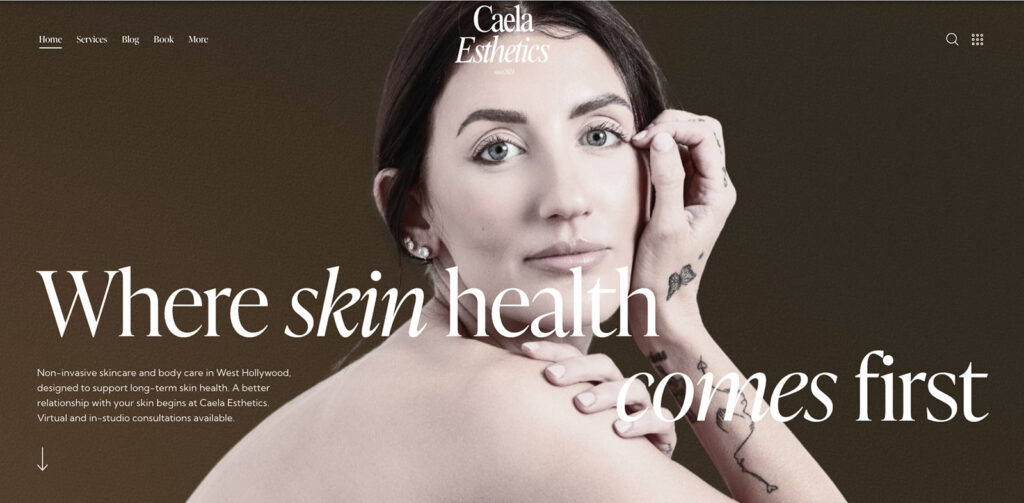
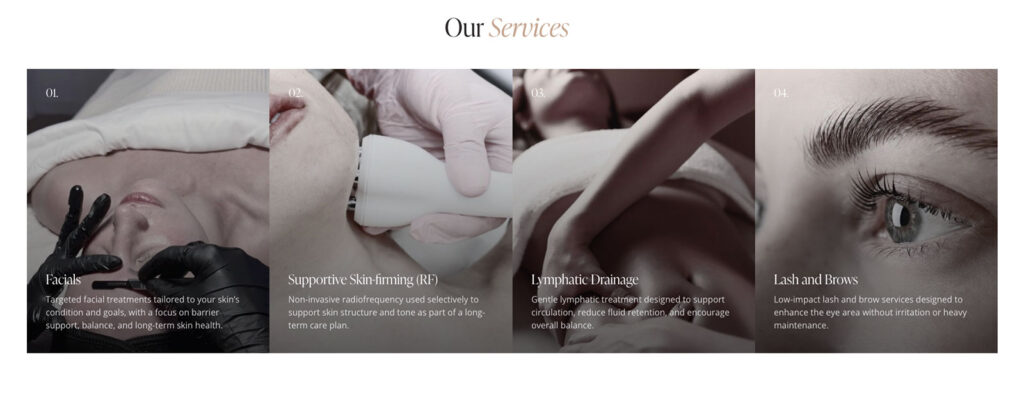
One of our med spa clients, Caela Esthetics, had a template-based website with limited SEO structure and a booking experience that leaned heavily on a third-party platform.
The website existed, but it was not doing enough heavy lifting for visibility or bookings.
We redesigned the site on a custom WordPress structure, reworked the homepage and key service pages around relevant search terms, strengthened the technical SEO foundation, added schema markup, and built the experience with mobile users in mind.
We also integrated Vagaro directly into the website, so clients could move from learning about the services to booking without feeling like they had been sent somewhere else.
Within 7 days, the website began ranking on the first page of Google for core service keywords.
More importantly, the new site supported the full client journey: discovery, trust, service education, and booking. Instead of relying too heavily on a third-party booking platform to carry the experience, the website became a stronger part of how people found, understood, and booked with Caela Esthetics.
That is what happens when SEO, website structure, and booking experience work together. You can read more about the strategy behind this kind of rebuild in this article on website redesign SEO mistakes.
For salons, this is the real goal of SEO: not just more traffic, but a website that helps people find you, trust you, and book with you.
11. Build local citations, backlinks, and track what is working
A backlink is a link from another website to the salon’s site. For salons, these might come from local blogs, wedding vendors, beauty publications, community events, business associations, partnerships, charities, or sponsorship pages.
Local citations are mentions of your salon’s name, address, and phone number on trusted platforms like Google Business Profile, Facebook, Apple Maps, Bing Places, Yelp, industry directories, local business directories, and social profiles.
Make sure your business information is consistent everywhere. Your salon name, address, phone number, website, and booking links should match across platforms.
You do not need hundreds of links overnight and SEO is not something you set once and forget.
To improve your results over time, you need to track what is working.
| What to track | Where to check | Why it matters |
| Search queries | Google Search Console | Shows what people search before finding your website |
| Top service pages | Google Analytics and Search Console | Shows which services are gaining visibility |
| Direction requests | Google Business Profile insights | Shows local intent and real-world interest |
| Clicks to call | Google Business Profile and website analytics | Shows whether people are taking action |
| Booking clicks | Website analytics and booking platform data | Shows whether visibility is turning into appointments |
| Reviews and ratings | Google Business Profile | Shows reputation growth and client trust |
| Local rankings | SEO tools or manual checks | Shows whether your salon is improving for priority searches |
Do not only track rankings. Track business outcomes.
For a salon, the real question is not just, “Are we getting more traffic?”
The better question is:
“Are more of the right clients finding us and booking?”
Ready to improve your salon’s Google visibility?
If your salon is ready to show up more clearly on Google, strengthen your local presence, and turn more nearby searches into bookings, Narratives by Nazar can help you build a strategy that feels intentional, manageable, and aligned with your business.
From local SEO and website content to service pages, Google Business Profile optimization, and conversion-focused web design, we help beauty and service-based businesses create marketing that supports real visibility and real growth.
FAQs About Hair Salon SEO
How much does SEO cost for a hair salon?
Costs vary widely depending on whether a salon handles SEO in-house or works with an agency, and which services are included (technical fixes, content creation, local SEO management, and so on). Rather than a fixed price, it’s best understood as an ongoing investment scaled to the salon’s goals and current website condition.
How long does it take to see SEO results for a salon?
SEO is generally a longer-term strategy. While some changes, like Google Business Profile updates, can affect local visibility relatively quickly, broader improvements in rankings and organic traffic typically build over several months of consistent effort.
Is SEO worth it for a small or independent salon?
Yes — local SEO in particular is often more accessible for small, independent salons than for large national brands, because local search results reward proximity, relevance, and trust signals like reviews, which independent salons can build directly with their existing client base.
Do I still need a website if I use Booksy or Instagram for bookings?
A booking platform and social media profiles are valuable, but a website gives a salon a space it fully controls for SEO — including service pages, blog content, and technical optimization — that can’t be achieved on third-party platforms alone.
SEO vs. paid Google Ads for salons — which should come first?
The two serve different purposes: paid ads can generate visibility quickly but stop working once spending stops, while SEO builds visibility that continues to work over time. Many salons benefit from starting with the local SEO foundations in Steps 1–5, since those also make any future ad spend more effective.
Should a salon do SEO in-house or hire an agency?
This depends on the salon’s available time and the complexity of the work involved. Steps like claiming a Google Business Profile or responding to reviews are manageable in-house, while ongoing content strategy, technical fixes, and ongoing review tracking are often where salons bring in outside help.