

Short answer: To find med spa content ideas patients are already searching for, enter your core treatments into Google Trends, set the location to the area you serve, and check the Rising queries list for questions gaining interest. Confirm the strongest ideas in a keyword tool like Semrush, then answer the patient question behind each one in a blog post, FAQ or short video. That’s the core of effective med spa content marketing.
Key takeaways
- Rising queries in Google Trends show which treatment questions are growing fastest, often before other clinics write about them.
- Google Trends shows relative interest, not search volume, so confirm ideas in a keyword tool.
- Since January 2026, Gemini in Google Trends can suggest up to eight related searches, so you don’t need the right keyword to start.
- One patient question can become a blog post, a Reel, a Google Business Profile post and an email.
Many med spa content calendars are built around what the practice wants to promote this month. Patients are searching for something more specific: how much a unit of Botox costs, what to do after treatment, whether Xeomin is different from Botox. That gap is where good med spa content marketing begins.
In this guide
- What is med spa content marketing?
- What should a med spa post about?
- The old way vs. the new way
- What’s new in Google Trends
- How to use Google Trends
- What Bay Area patients are actually searching for
- How to know if a trend is worth it
- How to turn one search into a month of content
- A simple monthly workflow
- FAQ
What is med spa content marketing?
Med spa content marketing is the creation and distribution of useful treatment information through website pages, articles, videos, social posts, and emails.
It helps prospective patients understand their options and evaluate your practice. It also supports existing patients with preparation, aftercare, and follow-up information.
Each part of the strategy has a role:
- Treatment pages explain your services, providers, location, and consultation process.
- Articles and FAQs answer questions that need more detail.
- Social content introduces your team and makes useful explanations easier to discover.
- Email continues the conversation with interested prospects and existing patients.
- Clear contact and booking paths help people act when they are ready.
The goal is trust, not viral reach.
What should a med spa post about?
Most useful med spa content falls into four types:
- Comparisons: Botox vs. Xeomin, RF vs. traditional microneedling
- Practical questions: cost, downtime, aftercare, number of sessions
- Seasonal timing: when to start laser treatments before summer
- Local relevance: what patients in your area are searching for right now
To find those questions, combine search data with what patients tell you directly:
| Source | What it tells you |
|---|---|
| Google Trends | Which treatments and questions are gaining interest, when and where |
| Keyword tool (e.g., Semrush) | Estimated monthly search volume and competition |
| Consultations, DMs and comments | The exact words patients use, and your best source of med spa social media ideas |
| Patient reviews | What patients value most after treatment |
To hear how patients phrase their questions, spend 15 minutes on:
- Your Instagram comments and DMs: questions that repeat are content ideas waiting to happen.
- TikTok search: type a treatment name and look at the autocomplete suggestions and the most-commented videos.
- Reddit: communities like r/SkincareAddiction and r/PlasticSurgery are full of detailed patient questions.
If you’re deciding what to post for a med spa this month, prioritize questions that show up in more than one place. For Instagram-specific ideas, see what to post on Instagram as a beauty brand.
The old way vs. the new way to plan med spa content
The old way to plan med spa content starts with the treatment you want to promote. The new way starts with what patients are searching for around that treatment.
Say your clinic wants more microneedling content.
The old way: You write “5 Benefits of Microneedling,” publish it and hope it gets found. It’s accurate, but it reads like every other clinic’s version, and it may not answer what patients are actually asking.
The new way: Before writing anything, you check what people are searching for around microneedling. When we did this for the Bay Area over the past 12 months, searches for “microneedling” were up 90% on the previous year, and the related searches pointed to specific questions: RF microneedling (the #1 related search), “microneedling with radiofrequency” (+250%), “microneedling price” (+200%), at-home microneedling (+70%) and “microneedling with PRP near me” (Breakout). The strongest question becomes your blog post, and the rest become FAQs, Reels and emails.
| The old way | The new way | |
|---|---|---|
| Starts with | The treatment you want to promote | What patients are searching for around it |
| Typical topic | “5 Benefits of Microneedling” | “RF Microneedling vs. Regular Microneedling: Cost and Results” |
| Result | Generic content that competes with every clinic | Specific answers to questions patients are already asking |
What’s new in Google Trends?
In January 2026, Google rebuilt the Google Trends Explore page with Gemini. The biggest change: you no longer need the right keyword to start, because Gemini suggests related searches for you.
| New feature | Why it matters for your med spa |
|---|---|
| Gemini side panel finds and compares trends for an area of interest | Start with a broad idea like “non-surgical skin treatments” instead of guessing exact keywords |
| Up to eight suggested terms fill the chart automatically | See related treatments side by side, e.g., Botox, Dysport and Xeomin |
| Suggested Gemini prompts for follow-up questions | Uncover angles you wouldn’t have thought to check |
| More terms to compare at once | Compare your full treatment menu in one view |
| Twice as many rising queries on each timeline | More early signals about which patient questions are growing |
In practice: We typed “skin treatments in the San Francisco Bay Area” into the Gemini panel. In one step, it charted eight treatments for the San Francisco–Oakland–San Jose metro. Over the past year, Botox had by far the highest average interest (75), followed by microneedling (38) and acne treatment (20), with chemical peels (7) and HydraFacial (6) far behind. Before the update, you’d have had to think of all eight yourself and add them one by one.
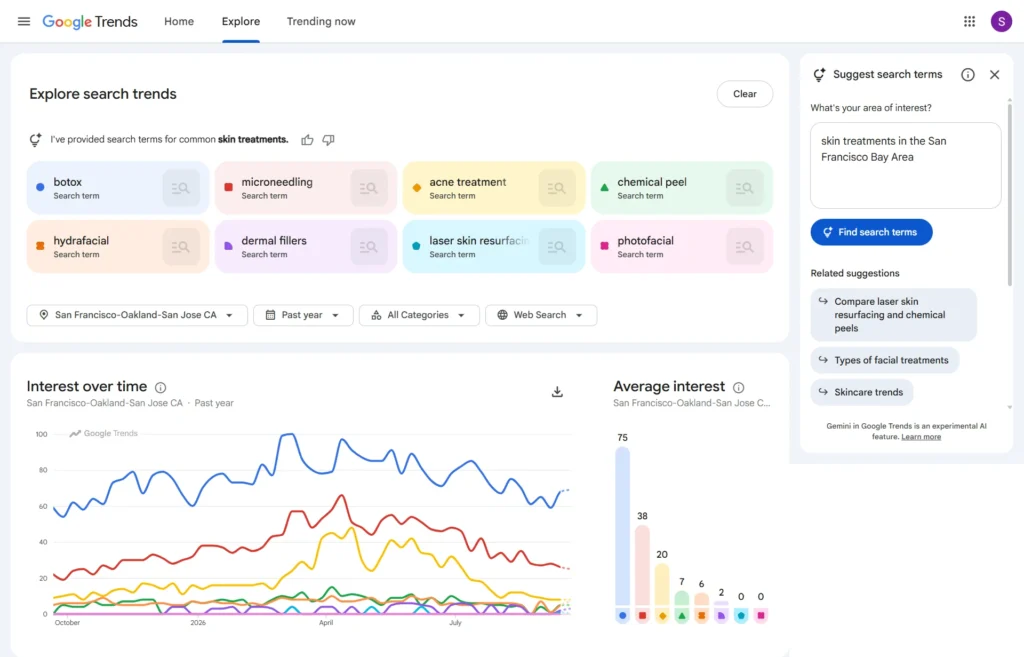
Gemini in Google Trends suggested eight skin treatments to compare for the San Francisco Bay Area. Botox led with an average interest of 75 over the past year.
A quick note: Google Trends labels Gemini an experimental AI feature, and the new Explore page launched on desktop first, rolling out gradually. If you don’t see it yet, it may not have reached your account.
How do you use Google Trends for med spa content marketing?
Google Trends is a free Google tool that shows how search interest in a term changes over time and by location. Most guides on how to use Google Trends for SEO are written for general marketers. For a med spa, four settings matter most.
Choose a search term or a topic
A search term measures the exact words entered. A topic groups related searches, including different spellings and languages (Google explains the difference here).
In practice, try both. When we searched the Bay Area over the past 12 months, the “Microneedling” topic showed a single spike and almost no other data, while the plain search term “microneedling” showed steady interest, up 90% on the previous year. If one looks empty, switch to the other before concluding nobody is searching.
Set your location to your actual market
Local interest is what fills your appointment book, so set the location to where your patients live. A Bay Area practice would choose the San Francisco–Oakland–San Jose metro. An Orange County practice would choose the Los Angeles metro, since Google Trends groups Orange County into the Los Angeles market.
If Google Trends says there isn’t enough data, switch between the topic and the search term, lengthen the time range, or widen the location to your state.
Check Rising queries, not just Top queries
Top queries are the searches most often made alongside your term. Rising queries are the related searches growing fastest in your chosen time period. A rising query labeled Breakout grew by more than 5,000%, according to Google. Rising queries are where you often find topics before other clinics have written about them.
Know what a score of 100 means
A Google Trends score of 100 does not mean 100 searches. Google scales results from 0 to 100 based on the highest point of interest for your chosen time and location. Google Trends shows relative interest, not search volume.
What are Bay Area patients actually searching for?
To show what this looks like with real data, we searched Google Trends for the San Francisco–Oakland–San Jose metro (data pulled September 25, 2026). We used the Bay Area because it’s our home base, but you can track cosmetic treatment trends the same way in Orange County, Los Angeles, San Diego or wherever your patients live.
Botox questions point to price and provider choice
In the supplied past-year Botox snapshot:
- “best botox” showed a +90% change.
- “botox price” showed a +160% change.
- Rising queries included questions about per-unit cost, nearby providers, and lying down after treatment.
Botox: provider, price, aftercare and comparison questions are rising
We searched “botox” over the past 12 months. Five patterns stood out in the related searches:
| Pattern | Real Bay Area searches (change vs. previous year) | Content idea |
|---|---|---|
| Choosing a provider | “best botox” (the #1 related search, +90%), “best botox near me” (+170%), “best place to get botox near me” (+2,850%) | A guide to choosing a Botox provider: training, product, consultation process |
| Price | “botox price” (+160%), “botox deals near me” (+130%), “how much is a unit of botox” (Breakout) | A pricing page explaining per-unit pricing and, if you offer them, memberships or packages |
| Aftercare | “botox aftercare” (+150%), “how long does botox take to kick in” (+100%), “how long after botox can you lay down” (Breakout) | An aftercare FAQ and a post-appointment email |
| Comparing brands | “xeomin vs botox” (+80%), “xeomin” (+30%), “dysport” (steady at -3%) | A provider-reviewed Botox vs. Dysport vs. Xeomin comparison |
| Newer uses | “what is masseter botox” (+160%), “botox for jaw pain” (+100%), “dental botox” (+70%) | Pages explaining masseter and jaw-area treatments, if you offer them |
Just as useful is what to skip:
- “Hair botox” (+100% for “botox for hair”) is a salon conditioning treatment that doesn’t contain botulinum toxin. It’s rising, but it isn’t a med spa topic.
- Celebrity and one-off searches such as “millie bobby brown botox” and “ronaldo botox” were labeled Breakout, as was a cluster of “planned parenthood botox” searches. Spikes like these are usually driven by news, not ongoing patient demand, so check what’s behind them before building content around them.
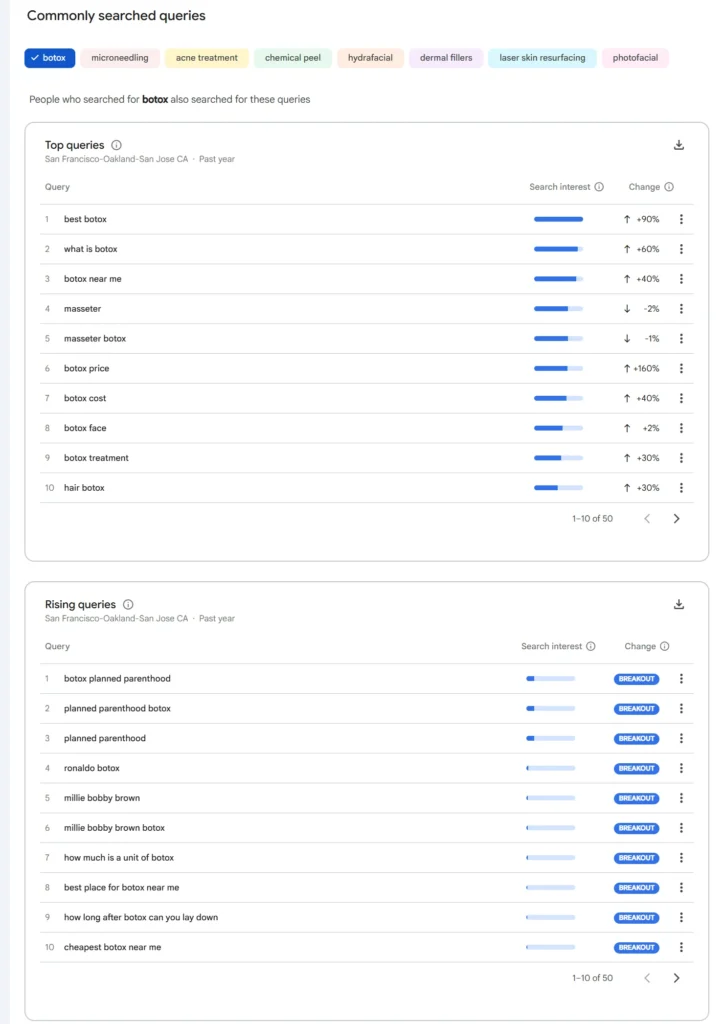
Top and rising Botox searches in the San Francisco–Oakland–San Jose metro, past 12 months (pulled September 25, 2026).
Laser hair removal: cost, “near me” and competitor brands
Over the past five years, Bay Area interest in laser hair removal was low and sporadic until early 2025, apart from a one-off spike in early 2023. Since then it has climbed steadily and stayed consistently higher through 2026. (The dotted section at the end of a Google Trends graph is partial data for the current period, so don’t read the final dip as a real drop.)
| What patients searched | What it signals | Content idea |
|---|---|---|
| “how much is laser hair removal” | Price is a deciding factor | “How Much Does Laser Hair Removal Cost in the Bay Area?” |
| “laser hair removal near me” | Patients want someone close by | An up-to-date Google Business Profile and a location-specific treatment page |
| “sev laser,” “laseraway” | Patients already know the big laser chains | A guide to choosing a provider: technology, training and results |
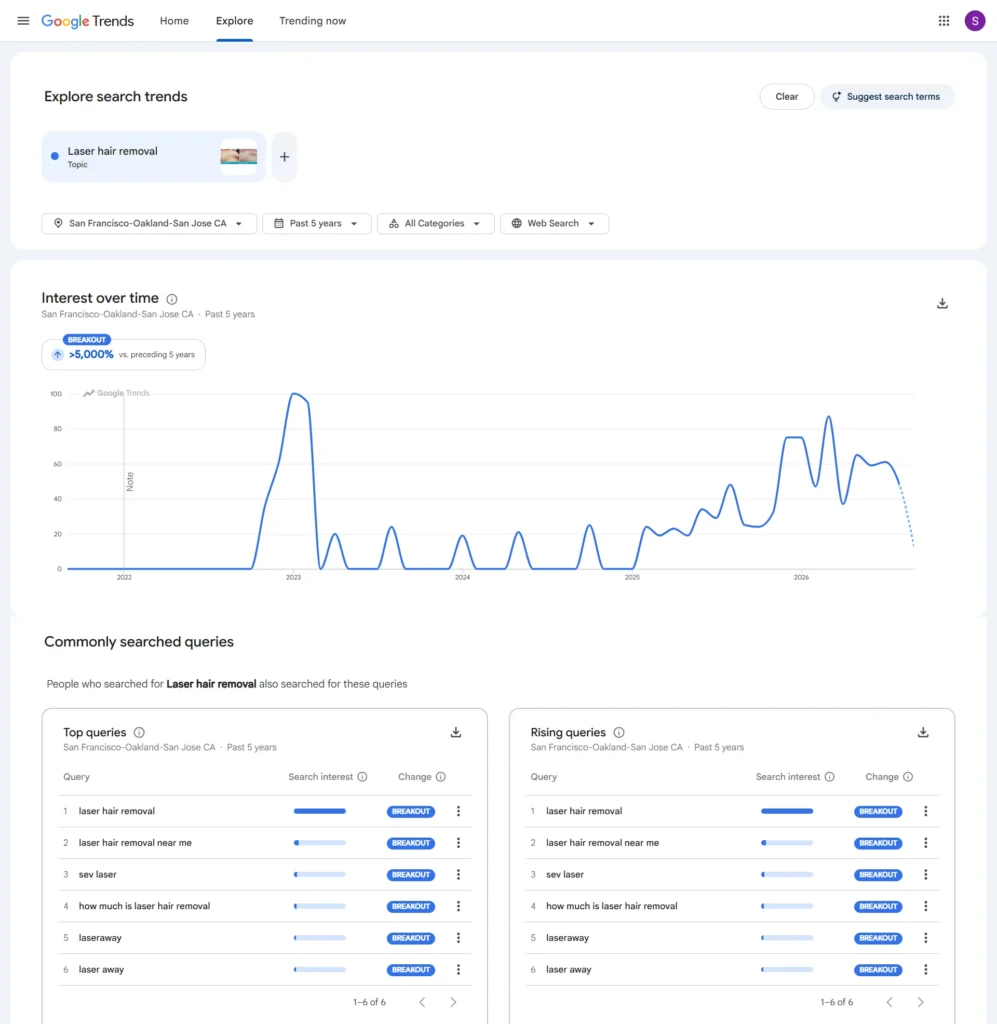
Laser hair removal interest in the San Francisco–Oakland–San Jose metro over five years, with related searches (pulled September 25, 2026).
What the Bay Area data tells a local med spa
Across both treatments, the same three themes kept coming up in the Bay Area data: price, trust in the provider and practical “what happens next” questions. None of them is “5 Benefits of Botox.” Each is a question local patients are already asking, and each is something a clinic website can answer directly.
Because Google Trends topics include searches in other languages, the Microneedling topic also surfaced a Chinese-language search (微针, “microneedling”), and Botox searches included “botox 中文” (“botox Chinese”). The data is limited, but it’s a reminder that Bay Area patients don’t all search in English.
A note on the data: at the metro level, Google Trends often has limited data for specific treatments. Google shows very low-volume searches as 0 and adds small random fluctuations to protect privacy, which is most noticeable on low-volume searches. That’s why lines can look spiky and many searches get labeled “Breakout.” Treat results like these as direction, not precise measurement.
How do you know if a trend is worth creating content around?
Google Trends is the starting point for keyword research for a med spa, not the finish line. Use Trends to spot direction, then a keyword tool like Semrush to confirm there’s enough demand.
| Question | Google Trends | Semrush or similar |
|---|---|---|
| Is interest rising or falling? | Yes | Basic 12-month trend |
| Where is interest strongest? | Yes, down to metro/city | Mostly country-level |
| How many monthly searches? | No | Yes (estimated) |
| How hard is it to rank? | No | Yes (keyword difficulty) |
Skip or deprioritize a trend when:
- You don’t offer the treatment.
- The spike came from a one-off news story or viral video and has already faded.
- Interest is concentrated somewhere you don’t serve.
- You can’t address the topic accurately and responsibly.
A trend is a signal to research, not an instruction to publish.
How do you turn one search into a month of content?
Take one question and answer it in every format your patients use. In our Bay Area data, one of the fastest-rising Botox questions was aftercare (“botox aftercare,” +150%). Here’s how that one search becomes a month of content:
| Channel | Content |
|---|---|
| Blog / treatment page | “Botox Aftercare: What to Do (and Avoid) in the First 24 Hours” |
| Instagram Reel or TikTok | A provider answering “Can I lie down after Botox?” in 30 seconds |
| Carousel | A day-by-day timeline of when results start to show |
| Google Business Profile post | A short aftercare tip plus a link to book |
| An aftercare checklist sent right after each appointment |
The same approach works for any of the med spa blog ideas above, from a pricing explainer to a Botox vs. Xeomin comparison. For help with each channel, see our local SEO, Instagram marketing and email marketing services.
Treatment content should be reviewed by a licensed provider and should avoid promising specific results.
A simple monthly med spa content marketing workflow
This process can take about an hour a month and fits alongside the rest of your med spa marketing strategy: local SEO, reviews and email.
- Clarity: Pick three to five treatments, check Rising queries for your metro, and note repeated questions from consultations and DMs.
- Strategy: Check the best ideas in a keyword tool, drop anything that fails the checklist above, and choose one or two patient questions for the month.
- Execution: Create one in-depth piece, then turn it into social, Google Business Profile and email content (here’s how to plan a month of social content in one day). Review what performed and feed it into next month.
A planning table you can copy:
| Treatment | Signal | Patient question | Keyword tool check | Main piece | Reused as | Publish by |
|---|---|---|---|---|---|---|
| Botox | Rising query | What should I do after Botox? | Enough volume, low difficulty | Blog post | Reel, carousel, GBP post, email | [date] |
| Botox / laser hair removal | Price searches | How much does it cost? | ||||
| Botox / Dysport / Xeomin | Comparison | What’s the difference? |
Frequently asked questions
What are effective med spa marketing ideas?
The most effective med spa marketing ideas (sometimes searched as medical spa marketing ideas) combine patient education with local visibility: treatment FAQs based on real patient questions, before-and-after content with proper consent and professional photos, an active Google Business Profile, email for past patients, and short-form video that answers common questions.
How do I rank my med spa locally?
To rank a med spa locally, keep your Google Business Profile complete and active, earn steady patient reviews, create a dedicated page for each core treatment, and publish content that answers the questions patients in your area are searching. Local SEO builds over months, not weeks.
Is Google Trends free?
Yes. Google Trends is free to use at trends.google.com.
Start with what your patients want to know
Google Trends won’t build your med spa content marketing strategy for you, but it gives you a far better starting point than guesswork: real questions your patients are already asking.
If you’d like help turning local search trends into a content plan for your med spa, whether you’re in the Bay Area, Orange County or elsewhere in California, get a free personalized quote.