
According to Zenoti, over 80 percent of clients now prefer booking appointments outside regular business hours. Late at night. Early in the morning. In between meetings.
Clients are no longer booking when your business is available to reply. They are booking when the decision feels right.
This is why scheduling now functions like a receptionist that never sleeps. One that should represent your professionalism, show availability clearly, and confirm appointments 24/7.
It is also a two-way system.
While it should create convenience for clients, it protects your business just as much. Your deposits and cancellation policies are applied consistently. Your reminders are sent without follow-up. Your no-shows are reduced. Your boundaries are held without friction.
Over time, that consistency does more than fill your calendar. It makes rebooking with you easier. It supports follow-ups. It creates the kind of predictability that leads to stronger reviews and better local visibility.
In competitive markets like San Francisco and San Mateo, those details are everything.
This guide looks at scheduling apps used by hairstylists, nail artists, and lash techs in the Bay Area through that lens. Not as tools to adopt, but as systems that align with how your clients already behave today.

What To Look For In A Scheduling App
The right scheduling app does more than organize appointments. It creates consistency. That consistency shows up in how clients experience your business, how easily they rebook, how often they leave reviews, and how visible your business becomes locally over time.
Here are the criteria that actually make a difference.
1. Easy Client Booking
At the booking stage, intent is fragile.
If the process feels slow, confusing, or overly demanding, they leave.
Studies show that clients are up to 70 percent more likely to abandon a booking if the process feels complicated or time-consuming.
An effective scheduling app removes friction at the exact moment interest peaks. Clear service options, visible availability, and a simple confirmation flow are not nice-to-haves. They are conversion points.
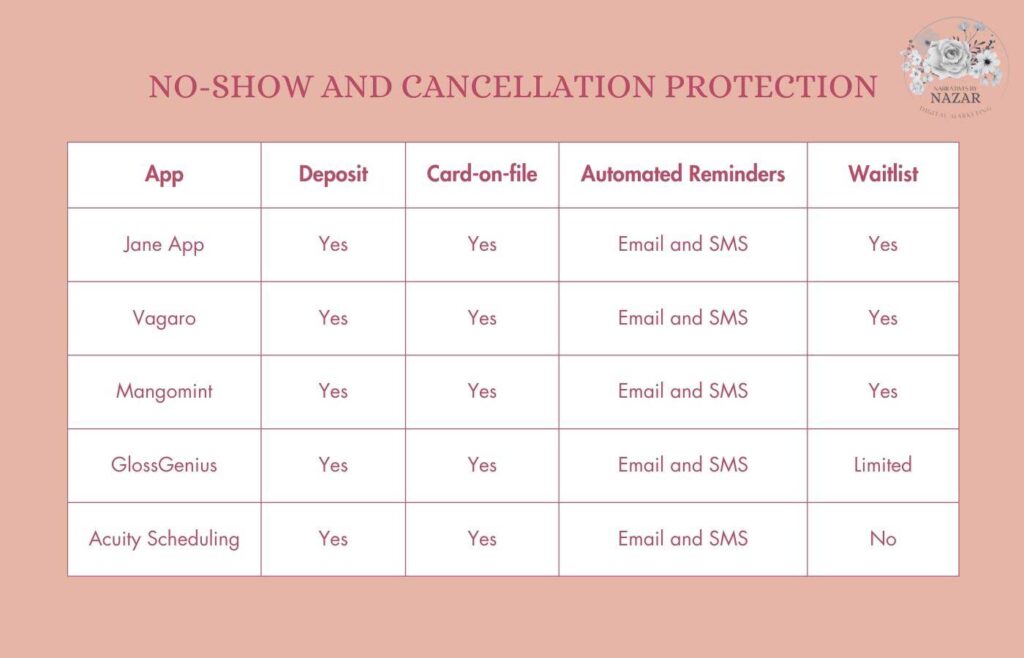
2. Deposits Or Card-On-File
This is one of the most misunderstood features, and one of the most important.
Deposits and card-on-file systems are not about being strict. They are about setting expectations clearly and early.
When a booking requires a small commitment, behavior changes. Clients are more likely to show up, cancel with notice, or communicate changes instead of disappearing. The system enforces boundaries quietly, without putting the business owner in the uncomfortable position of chasing confirmations or explaining policies repeatedly.
In practice, this protects time, income, and energy.
3. Automated Reminders
Fact: No-shows are rarely intentional. They are often the result of forgetfulness or poor timing.
Businesses using online booking with automated reminders see no-show rates drop by as much as 25 to 75 percent. That reduction alone can change how predictable a schedule feels week to week.
Good systems handle reminders automatically through email and SMS, reinforcing professionalism while removing manual follow-ups from your workload.
4. Waitlists
This feature does a lot of heavy lifting.
Cancellations happen. A waitlist decides whether they cost you.
It allows open slots to be filled automatically when someone cancels, often within minutes. Clients who want an earlier appointment are notified, and the first to respond secures the spot.
Instead of reacting, the system recovers the time.
5. Mobile-Friendly Setup
This is no longer optional.
More than 65 percent of salon and beauty bookings now happen on mobile devices. Clients are booking from their phones, not desktops.
If a scheduling app does not work seamlessly on mobile, it creates friction at the most critical point in the journey. The best systems are designed with mobile-first behavior in mind, both for clients booking and for business owners managing their schedules on the go.
With these foundations in place, comparing specific platforms becomes much clearer.
A Few Questions To Ask Before Choosing
Beyond features, the right scheduling app depends on the context of your business.
Before comparing platforms, it helps to be honest about a few fundamentals.
Your Current Team Size
Some scheduling systems are designed for independent providers. Others are built to support multiple staff, overlapping schedules, and shared resources.
If you are working solo, simplicity matters. If you are managing a team, visibility across calendars and services becomes critical. Choosing a system that does not match your team structure often leads to workarounds and frustration later on.
Your Budget
Pricing varies widely, and cost often reflects complexity.
Entry-level tools can be effective when your operations are straightforward. As businesses grow, more advanced systems can justify higher pricing by reducing admin time, minimizing missed appointments, and improving scheduling efficiency.
The goal is not to find the cheapest option. It is to choose a system that pays for itself through consistency and protection.
System Versus Visibility
Not all scheduling apps are built the same.
Some focus purely on internal operations. Others also support discovery, client reminders, rebooking prompts, and review requests that help increase visibility over time.
For some businesses, the scheduling experience lives entirely within a platform. For others, it works best when it connects seamlessly to a website where clients can learn, trust, and book in one place.
If your business is already well-established, structure may be the priority. If growth and local visibility matter, it is worth considering how your scheduling system supports the full client journey, not just the appointment itself.
Top 5 Scheduling Apps For Beauty Professionals In The Bay Area
Each of the platforms below supports a different type of beauty business. The goal here is not to crown a single winner, but to give you enough context to recognize which system fits how you operate today and how you plan to grow.

Jane App
Snapshot
- Founded: 2012
- Company origin: Canada
- Primary users: Wellness, beauty, and medical aesthetics practices
- Availability: United States, Canada, and select international markets
- Review reputation: Consistently rated above 4.5 stars on G2 and Capterra for usability and customer support
Worth Knowing
- Jane App was originally built for healthcare and wellness providers, which is why it is particularly strong in structure, documentation, and reliability compared to many beauty-first tools.
- The platform is widely used in regulated environments, including medical aesthetics, where clarity, compliance, and consistency matter.
- Jane App is frequently praised for its customer support and onboarding experience in long-form reviews.
- It maintains a strong presence in both the U.S. and Canada, making it one of the more internationally balanced platforms in this space.
Dr. Chantal Lunderville, medical director for many of our beauty clients, is a Jane App brand ambassador. Ask us about potential special pricing!

Vagaro
Snapshot
- Founded: 2009
- Company origin: United States
- Primary users: Salons, spas, fitness, and beauty businesses
- Availability: United States, Canada, and select international markets
- Review reputation: Rated around 4.3 stars on G2 and over 4 stars on Capterra, with a high volume of reviews
Worth Knowing
- Vagaro was one of the earliest platforms to position itself as an all-in-one system for salons and wellness businesses.
- It includes a built-in marketplace where clients can discover local beauty businesses, making it both a scheduling and discovery tool.
- Vagaro is commonly used by salons offering mixed services such as hair, nails, massage, and skincare.
- Many clients already recognize the Vagaro booking interface, which can reduce friction when booking with a new business.
This familiarity is part of why Vagaro remains a popular option in busy, competitive markets.

Mangomint
Snapshot
- Founded: 2017
- Company origin: United States
- Primary users: Established salons and spas
- Availability: Primarily the United States
- Review reputation: Frequently rated around 4.8 stars for design, speed, and reliability
Worth Knowing
- Mangomint was designed with speed and operational flow as a priority, which is why many salon owners comment on how fast and intuitive it feels during busy days.
- The platform is often adopted by salons transitioning from manual systems or older software that no longer scales.
- Mangomint places a strong emphasis on efficiency and clarity rather than marketing features.
- It is particularly popular among higher-volume teams that need visibility across staff and services.
Mangomint tends to appeal to businesses that are already established and looking to streamline operations.

GlossGenius
Snapshot
- Founded: 2016
- Company origin: United States
- Primary users: Solo hairstylists, nail artists, and lash techs
- Availability: United States
- Review reputation: App Store ratings frequently above 4.8 stars with strong feedback from independent beauty professionals.
Worth Knowing
- GlossGenius was built specifically for independent beauty entrepreneurs rather than large salons.
- The platform places a strong emphasis on branding and aesthetics, which aligns well with Instagram-driven businesses.
- Many solo providers choose GlossGenius because it feels approachable and easy to use, even for those who are not tech-savvy.
- It is often described as feeling more like a consumer app than traditional business software.
For independent providers, the client-facing experience is a major part of their appeal.

Acuity Scheduling
Snapshot
- Founded: 2006
- Company origin: United States
- Primary users: Service professionals across industries
- Availability: Global
- Review reputation: Rated around 4.5 stars on G2 and Capterra, with strong feedback around flexibility and customization
Worth Knowing
- Acuity Scheduling is one of the older platforms in this category, which contributes to its wide range of integrations.
- It is used across many industries beyond beauty, including coaching, fitness, and professional services.
- Acuity became part of the Squarespace ecosystem, strengthening its website and calendar integrations.
- The platform is often chosen by users who prioritize rule-based control over industry-specific design.
Acuity tends to suit businesses that want flexibility and customization more than a beauty-first interface.
A Side-By-Side Look At The Top Scheduling Apps
No-Show And Cancellation Protection Comparison
Best Fit & Pricing Overview Comparison
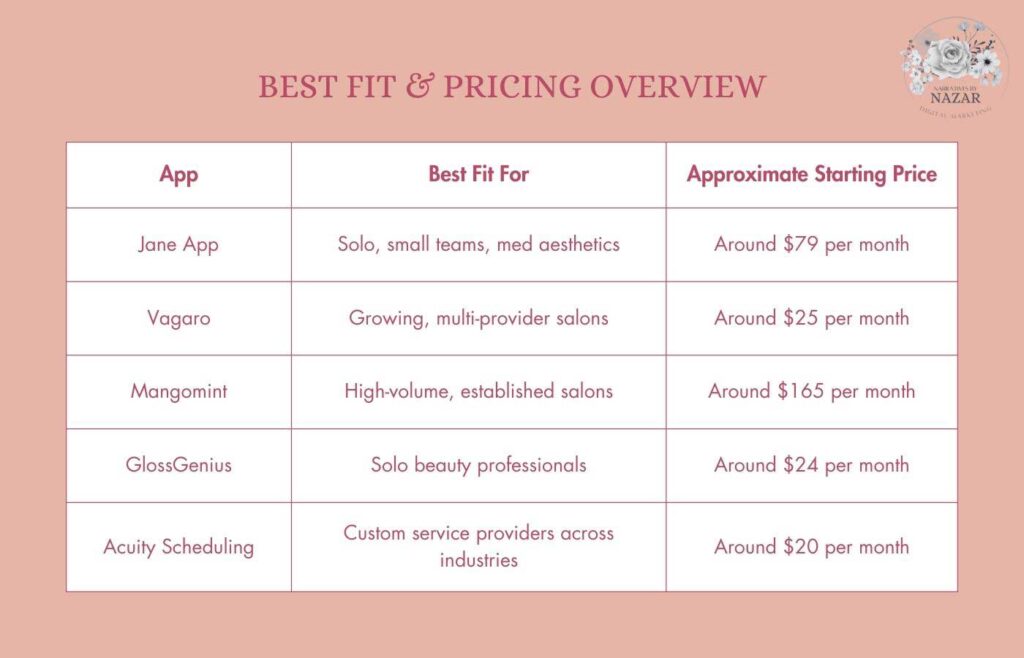
Pricing disclaimer:
Pricing and features change over time. Prices listed are approximate and provided for general comparison only. Always confirm current pricing directly with each platform.
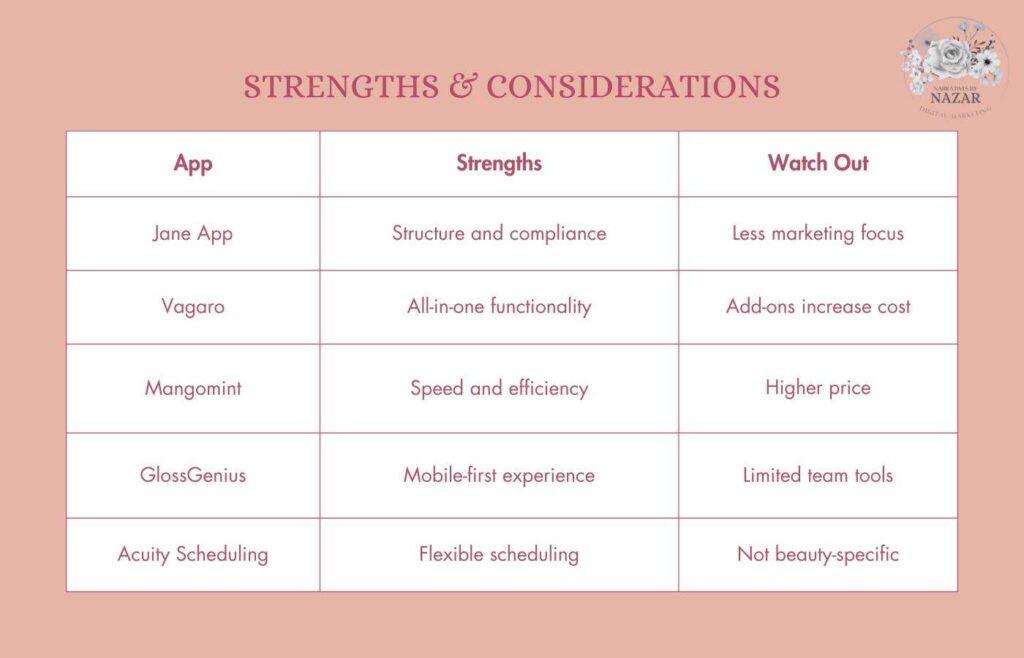
Strengths and Considerations Comparison
Final Words
Scheduling today is no longer just an admin tool. It is your business, your brand, and your conversion point.